
What If ADHD Means We Don’t Forget Childhood? Imaginary Friends and Folklore Names
What if ADHD means we forget less from early childhood?
I’ve been turning over a hypothesis in my head for a while now about ADHD. I don’t have the resources or credentials to test it properly, so I’m just putting it down here on my blog to get it out of my brain and into the world. Partly for me, partly in case anyone else has spotted this.
It started with two imaginary friends I had at age three who turned out to have names matching ancient folklore I couldn’t possibly have known.
The short version. What if ADHD is, at its root, the absence, or a much weaker version, of childhood amnesia? In other words, most people’s brains naturally “forget” or bury almost everything from their very early years, the memories, impressions, instincts, and patterns laid down before age 3 to 5. Mine, and maybe other ADHD brains, don’t forget as thoroughly. Those early layers stay more accessible, more vivid, more alive.

My Childhood Imaginary Friends: Mimmim and Galgy
When I was three or four years old, I had two imaginary friends. Mimmim and Galgy.
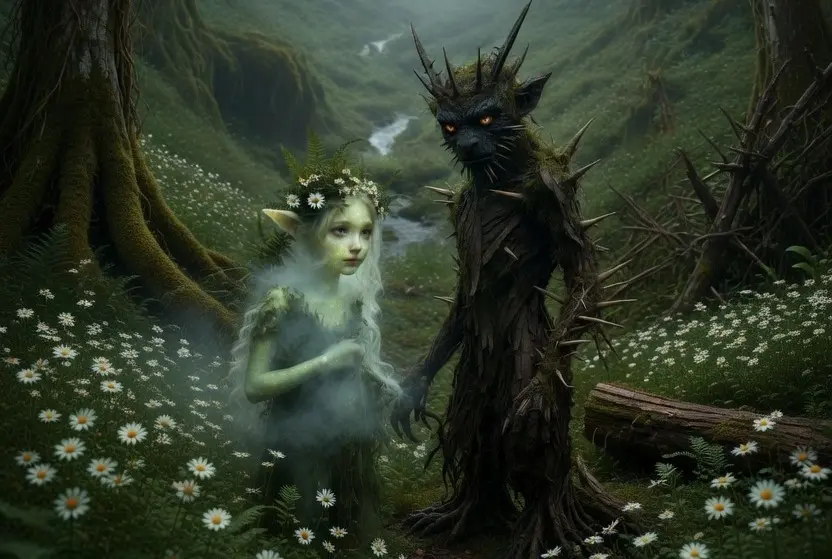
Mimmim was quiet, delicate, and careful. She, I always thought of her as a she, liked hidden places, under tables, behind curtains, inside wardrobes. She seemed delicate, like a strong breeze could knock her over, but she was wise, all-seeing, and clever. She showed me small, secret things like how to observe patterns in leaves, how to make shapes from shadows, and how to stay safe.
Galgy was the opposite. He was small, almost toy-like, but when I was scared, he grew when I needed him to. If something scared me or felt unfair, Galgy would grow and become stronger, louder, ready to fight. He was my protector, the one who stood up when I couldn’t. He didn’t talk much, but his presence felt reassuring and expansive, as if together nothing could stop us.
The weird thing is that years later, I discovered two real folklore figures that matched them almost exactly.

The Eerie Folklore Matches: Mimi Spirits and Galgameth
Mimmim is eerily close to the Mimi, or Mimih, spirits from Aboriginal Australian stories. They are tall, thin, fragile beings who hide in rock cracks to stay safe from the wind. They are ancient teachers who showed early humans how to hunt, cook, make fire, and paint on rocks. Helpful but mischievous, easily harmed if disrespected.
Galgy matches Galgameth, nicknamed “Galgy” in the 1996 film The Legend of Galgameth, based on older Korean folklore about a guardian creature. He begins as a tiny statue that comes alive, triggered by a child’s emotion, then grows huge by eating metal. He protects the weak, a young prince fighting an evil ruler, by destroying weapons and threats. Small at first, unstoppable when needed.
How Mimmim and Galgy Represent My Autism and ADHD Sides
I have both autism and ADHD, AuDHD, and Mimmim and Galgy feel like they could be expressions of my two halves.
Mimmim represented the autism side. Sensitive, detail-focused, needing safety and structure, preferring hidden or predictable places, always watching, and learning everything.
Galgy was the ADHD side. Energetic, expanding, protective, quick to grow when something matters, ready to leap into action or challenge.
These halves live in me today, in tension inside me. One wants calm, routine, depth. The other wants novelty, intensity, movement. They clash every day. A classic AuDHD internal conflict. Hide vs grow, order vs chaos. Yet they also provide balance. Wisdom plus bold defence, careful noticing plus fearless expansion.
What If ADHD Means We Remember More from Early Childhood?
I can’t help but think that those two imaginary friends weren’t random. They were my young brain giving shape to the two ways I experienced the world. And the fact that their names later matched ancient, scattered human stories makes me wonder if my mind, perhaps because of how ADHD keeps old layers alive longer, and autism holds patterns so tightly, was able to reach for universal ideas without any outside help.
They were my first protectors and teachers. And in a way, they still are.
How My Imaginary Friends Led to This ADHD Hypothesis
According to my hypothesis, ADHD is the brain’s failure to fully “forget” or suppress the hereditary, ancestral survival information we all carry from thousands of generations of human history. Most people’s brains prune and fade those early, collective imprints, the deep patterns, instincts, and archetypes that helped our ancestors survive. Mine didn’t prune them as hard.
Because I also have autism, those layers didn’t just linger and fade, they were held with intense focus and detail.
The spooky thing here that started this train of thought is that I gave them names that later matched two real, rare folklore figures I had zero exposure to.
“Mimmim” lined up with the ancient Mimi spirits, fragile, rock-hiding teachers from Aboriginal Australian stories.
“Galgy” lined up with Galgameth, the small statue that grows into a metal-eating guardian from a 1996 kids’ film based on older Korean folklore.
There is no possible way a toddler in 1970s England could have heard those names or stories. There was no internet, no iPhones, no folklore books and no family stories. They simply arrived in my head, fully formed, with the right names attached.
My Explanation: Why ADHD Might Mean Less Forgetting
Most people’s brains “forget” or suppress a lot of the old survival knowledge and instincts humans have carried for thousands of generations. In ADHD, that forgetting process is weaker, so more of those old bits stay accessible longer. With autism added in, AuDHD, those same bits get held onto even more tightly and clearly because of the intense focus and detail-processing that comes with it.
At age three or four, when most kids’ first memories and impressions are already fading fast, a thing called infantile amnesia, mine were still strong and vivid. In play, my brain turned those old, basic human survival instincts into two clear characters who matched exactly what I needed inside. A quiet, careful friend who stayed hidden and taught me small things, Mimmim, and a tough friend who was small but grew big to protect me when I felt scared, Galgy.
Because the normal forgetting process was weaker, from ADHD, and the details were held extra tightly, from autism, those characters came out fully formed, including names and personalities that later matched real folklore figures from completely different cultures, Mimi spirits and Galgameth or Galgy.
In other words, my brain didn’t just create imaginary friends with random names. It pulled up old, shared knowledge that most brains bury and gave it names I had no business knowing.
That’s why the story feels so complete. The very wiring that makes me AuDHD is the same wiring that let those echoes of ancient times appear as Mimmim and Galgy when I was tiny. They weren’t random. They were my brain doing exactly what my hypothesis says it does. Remembering what everyone else has forgotten.
The Real Science on ADHD, Memory, and Childhood Amnesia
To be clear, my hypothesis, that ADHD involves a weaker version of childhood amnesia, so early survival instincts, patterns, and impressions stick around more vividly, isn’t proven. No study has directly tested “ADHD brains forget less from ages 0 to 5.” But several pieces of real research line up with parts of it, or at least make the idea plausible.
- ADHD traits have deep evolutionary roots and have stuck around for tens of thousands of years. Multiple studies show ADHD isn’t a modern “defect”. Genetic variants linked to ADHD, like those affecting dopamine, have been preserved through human history. Recent research from 2024 and 2025 found that people with ADHD-like traits did better in simulated foraging tasks, switching patches faster when food ran low and gathering more overall. This fits the hunter-gatherer advantage idea. Impulsivity, novelty-seeking, and hypervigilance helped ancestors survive in unpredictable environments.
- Early memory and forgetting work differently in neurodivergence. Childhood amnesia, fading memories from before age 3 to 5, is normal for most people and is linked to brain maturation, hippocampus and prefrontal cortex development, with high neurogenesis overwriting early circuits. In autism, often overlapping with ADHD, a 2023 Trinity College Dublin study using maternal immune activation mouse models found male pups did not experience typical infantile amnesia. They retained early-life memories into adulthood that wild-type mice forgot.
- Some smaller studies on ADHD children show mixed early memory results. One found equal or even enhanced long-term episodic memory, personal events, compared to controls, despite working memory deficits. Another study noted that ADHD children had more involuntary memories, spontaneous recall, than non-ADHD peers.
- ADHD memory isn’t bad across the board. It’s selective. Most ADHD research focuses on working memory deficits, holding info in the moment, like instructions or where you put your keys, and some long-term retrieval issues. But this is about current, everyday forgetting. Not necessarily less fading of very early childhood impressions. In fact, some adults with ADHD report unusually vivid or persistent early emotional or sensory memories, though this is anecdotal or from small studies.
- ADHD brains often show stronger responses, in brain activation and attention capture, to emotional or novel stimuli during memory tasks. Studies find that emotional content can significantly boost memory performance in ADHD, sometimes matching or exceeding neurotypical levels, while neutral information is harder to retain. This suggests early survival signals, like fear, excitement, or novelty, might stick harder because they’re more salient.
Bottom line. The science strongly supports ADHD as an evolutionarily preserved trait with roots in ancestral survival advantages. It also shows that neurodivergence can alter early memory processes, for example reduced amnesia in autism models.

The Big Caveat: This Is Speculative, But Worth Exploring
You may say this is a huge leap of faith, or that this is the result of an overactive ADHD brain. Probably. Yes. No study yet says “ADHD equals less childhood amnesia” specifically. But this doesn’t mean it can’t be true. It’s just that nobody has tested the hypothesis yet.
My hypothesis extends these pieces. If ADHD keeps ancestral survival wiring more active and autism holds details tighter, early impressions could fade less and surface more vividly, like in my Mimmim and Galgy story.
My hypothesis is speculative, but grounded in real personal experiences, evolutionary psychology, memory development, and neurodiversity research. If it sparks anyone to study it properly, I’d love to see the results.
Has anyone else with ADHD or AuDHD noticed unusually vivid early memories or similar synchronicities? Drop a comment if it rings a bell.
Want more like this? For the latest articles, reflections, and practical support, head over to the blog home.
View Blog Home