Court Says Womanhood Is Just Genitals. I Know It’s Not.
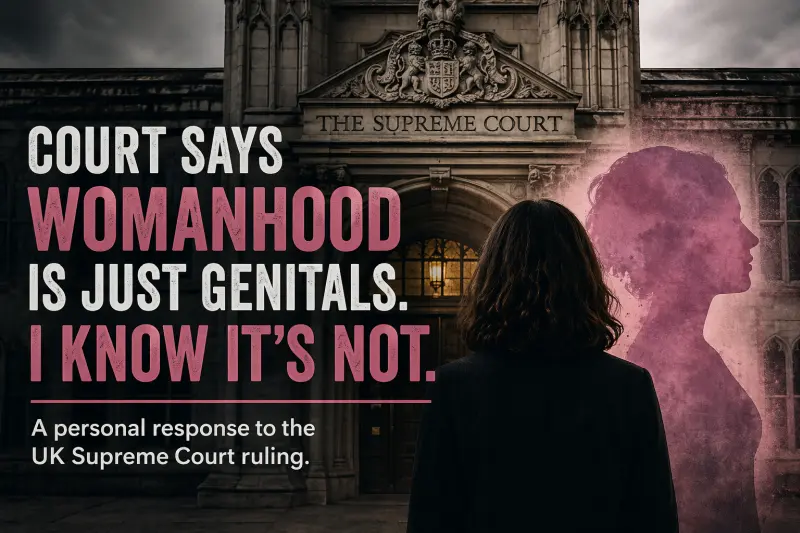
The Supreme Court ruled on womanhood. And got it badly wrong.

Updated April 2026:
This issue has moved back into public debate again, so I’ve
updated and republished this piece. The core point still stands.
UK Supreme Court biological sex rulings now define womanhood by anatomy, not identity
The court has decided that “woman” under the Equality Act means biological female, even if a person has a Gender Recognition Certificate. That means trans women can be lawfully excluded from single-sex spaces like toilets, prisons, and rape crisis centres.
That is being presented by some people as common sense. It isn’t.
This ruling does not just affect trans women. It reaches much wider than that.
It reduces womanhood to anatomy.
It tells people that identity, lived reality, vulnerability and actual human experience come second to a biological category on paper.
That is the part I find so bleak.
Because once you start reducing people to body parts, you are not protecting anyone. You are sorting them. You are policing them. You are narrowing who gets to belong.
This isn’t just about toilets
People keep shrinking this argument down to toilets, as if that makes it simpler. It doesn’t.
This affects:
- Women’s prisons
- Rape crisis centres
- Hospital wards
- Changing rooms
- Shelters
- Care homes
- Any service designated single-sex
It gives organisations the legal right to exclude people based on anatomy.
Not identity.
Not context.
Not risk.
Not trauma.
Just biology.
That is a very blunt instrument for something this human and this complex.
It doesn’t only hit trans people
I am male. I accept that. I am not claiming to be a woman, and I am not trying to step into a space that is not mine.
But I do know what it is like to move through the world in a way that does not fit neatly with what people expect from men.
Some men are softer, more emotionally open, less traditionally masculine. Some feel safer around women. Some have spent their whole lives being treated as wrong for not performing maleness properly.
That is not the same as being trans. It is different. Still, it creates a kind of recognition here, because the same rigid thinking sits underneath it.
The moment society starts acting as though bodies tell the whole story, a lot of people get crushed by that. Trans people most of all, but not only them.
Women get reduced. Men get boxed in. Anyone outside the expected script gets watched more closely.
Who enforces this?
This is the part people skip over.
If you are going to enforce biological sex only rules in women’s spaces, what does that actually look like in real life?
- ID checks at toilet doors
- Staff deciding who looks female enough
- People being challenged in changing rooms
- Support services having to judge bodies before offering care
And what happens when a woman does not look the way someone expects?
- Butch lesbians
- Cis women with facial hair
- Tall women
- Women with deeper voices
- Trans men who now get shoved toward women’s spaces because of birth sex
This does not create safety. It creates suspicion.
It invites scrutiny of anyone who looks a bit different, a bit masculine, a bit outside the approved shape.
What the ruling really says
The message underneath all of this is hard to miss.
Your body matters more than your personhood.
Your anatomy matters more than your lived reality.
That message lands hardest on trans women, nonbinary people and intersex people. But it also lands on women more broadly, because it drags womanhood backwards into something narrow, physical and inspectable.
That should alarm people far more than it seems to.
The irony is hard to ignore
A lot of the same voices cheering this on are not exactly known for caring deeply about women the rest of the time.
- They cut funding for women’s services
- They dismiss women’s pain
- They question survivors
- They push control dressed up as concern
So no, I don’t buy the idea that this is simply about protecting women.
It looks much more like power. Control. Gatekeeping. The old habit of deciding who counts and who does not.
What happens next?
This ruling will not stay neatly contained in a law report.
It will ripple outward.
- Services will tighten access
- Schools will get more nervous and more restrictive
- Gender-diverse people will feel less safe asking for help
- Women who do not look conventionally feminine will get watched more closely
And that is the bit people miss.
When you build systems around suspicion, the circle of harm always grows.
Final thought

The law has spoken.
That does not make it wise.
Womanhood is not just anatomy. Human identity is not just anatomy. People are not just anatomy.
Once you start pretending otherwise, you do damage that spreads far beyond the group you first aimed it at.
I think that is what makes this ruling so grim. Not just what it says on paper, but what it gives permission for afterwards.
Less compassion. Less nuance. More checking, more sorting, more exclusion.
And we already have far too much of that.

If this struck a chord, you can also read Feminine Men and ADHD: Where Do We Fit? or get in touch.
Want more like this? For the latest articles, reflections and practical support, head over to the blog home.
View Blog Home