
Common ADHD Challenges and How Coaching Can Help
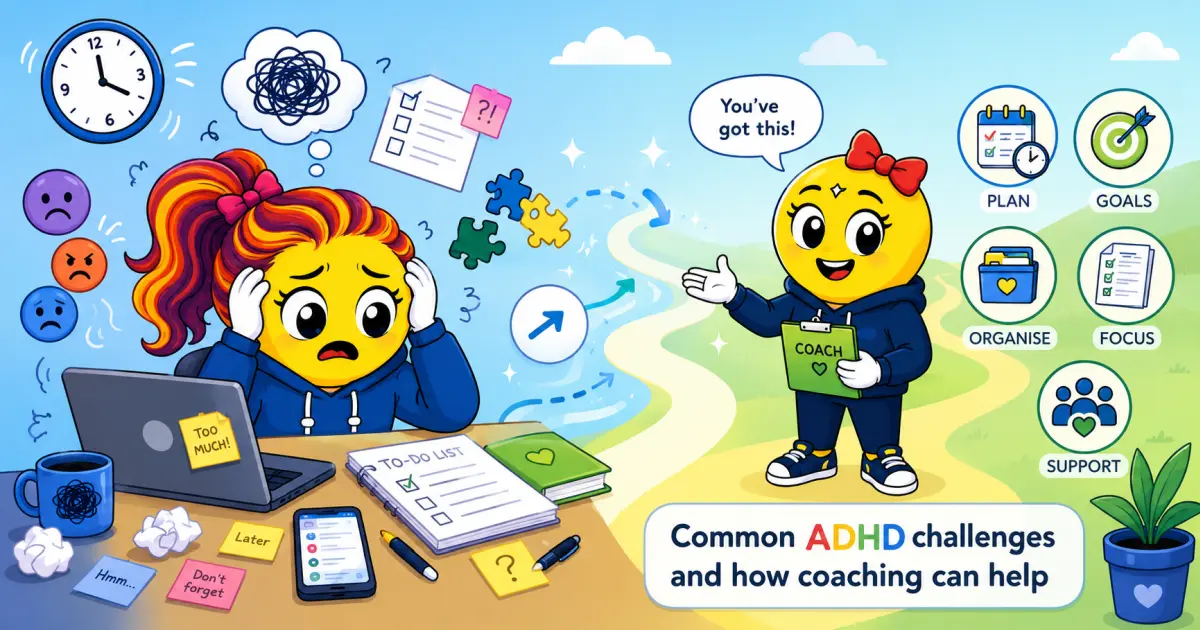
ADHD challenges rarely stay in separate boxes
ADHD rarely turns up as one neat problem.
You might sit down to answer an email, notice five other things, remember a task from Tuesday, get annoyed with yourself, then spend twenty minutes trying to decide where to start. By then the original email is still open.
This is why lists of ADHD symptoms can feel oddly disconnected from real life. Focus affects getting started. Working memory affects organisation. Time blindness turns a small delay into a last-minute panic. A difficult email can knock concentration sideways for the rest of the afternoon.
I see the same patterns in coaching. The problem someone brings to a session is often not one problem at all. It is a chain of smaller things feeding each other.
- You forget a task, panic when you remember it, rush it, make a mistake, then avoid the next similar task.
- You want to start, cannot choose the first step, look for a better system, then run out of time.
- You receive a short message, read the tone as criticism, replay it in your head and lose the concentration you needed for something else.
- You make a plan, forget the plan exists, then blame yourself for not following it.
None of this means you are incapable. It means the useful question is not always, “Why can’t I just do it?” A better question is, “What actually happens between deciding to do it and the point where it goes off track?”

Focus, motivation, procrastination and task initiation
These four are often bundled together as a motivation problem. That can be frustrating when you care about the task, know why you need to do it and still cannot make yourself begin.
The details are useful. Struggling to hold attention is not the same as struggling to begin. Delaying something because it feels unclear is not quite the same as drifting away from it every three minutes.
Focus and switching attention
ADHD focus is not simply a lack of attention. Many people can focus intensely when something is interesting, urgent or absorbing, then struggle with work that is repetitive, slow or full of interruptions.
The difficulty may be staying with one thing, returning after an interruption, or switching away from something that has grabbed your attention. The ADHD coaching for focus guide looks at these patterns in more detail.
Motivation that refuses to follow the plan
You can want an outcome and still feel no pull towards the steps needed to reach it. That gap can look baffling from the outside. It can feel worse from the inside because you know you care.
Coaching can help examine what gives a task enough interest, urgency, clarity or personal meaning to get moving. The ADHD motivation coaching guide covers this without reducing motivation to willpower.
Procrastination
Procrastination is often treated as a bad habit. In practice, the delay can be doing a job. It may be helping you avoid uncertainty, boredom, fear of getting it wrong, or the uncomfortable feeling of starting something with no clear edge.
The work is not to tell you to “just start”. You have probably tried that advice. The ADHD procrastination coaching guide looks at the different jobs delay can be doing and what can make action easier.
Task initiation
Task initiation is the strange experience of knowing exactly what needs doing and still not moving. Sometimes the task is tiny. Sometimes you are sitting in front of it. You are not confused about the goal, yet the starting point feels locked.
Breaking a task down can help, but not when the breakdown becomes another task. The ADHD task initiation guide explores ways to reduce the distance between intention and action.

Working memory, organisation and time blindness
This group causes a lot of the daily friction people blame on being careless or disorganised.
You can be intelligent, experienced and perfectly capable of understanding a complex problem, then forget why you opened a browser tab thirty seconds ago. Annoying. Also very different from not understanding the task.
Working memory
Working memory is the mental space used to hold information while you are doing something with it. When that space gets crowded, steps disappear. Instructions get lost halfway through. A thought can vanish while you are waiting for somebody else to stop talking.
The answer is not to try harder to remember everything. The ADHD working memory coaching guide looks at ways to move useful information out of your head and into places you can find again.
Organisation
Organisation problems are rarely solved by buying a prettier planner. I say that with affection for stationery, but also some experience.
A useful system has to survive ordinary life. It needs to be visible enough to remember, simple enough to use on a bad day and forgiving enough that missing Tuesday does not ruin the rest of the month.
The ADHD organisation coaching guide covers ways to build systems around how you already behave rather than around an imaginary version of you with a colour-coded morning routine.
Time blindness
Time blindness can mean misjudging how long something will take, losing awareness of time passing or struggling to feel the difference between “later” and “not now”.
This can create lateness, overfilled days and the familiar surprise of discovering that three small tasks have somehow eaten the entire morning. The ADHD time blindness coaching guide explores ways to make time more visible and plans more realistic.
Emotional overwhelm, impulsivity and rejection sensitivity
Not every ADHD difficulty is about productivity. Some of the hardest moments happen in conversations, relationships and the few seconds between feeling something and reacting to it.
These experiences can also affect work. A sharp comment in a meeting can stay in your head all day. A sudden decision can create weeks of admin. One awkward interaction can make you avoid a person you genuinely like.
Emotional overwhelm
When emotion arrives fast, the thinking part of the brain does not always get much time at the microphone. Anger, embarrassment, frustration or panic can fill the whole space before you have worked out what happened.
Coaching can create room to notice triggers, patterns and recovery needs. The ADHD emotional overwhelm coaching guide looks at practical ways to recognise what is building and respond with more choice.
Impulsivity
Impulsivity can show up in spending, speaking, messaging, changing plans, accepting work or making a decision because the discomfort of waiting feels worse than the possible consequences.
The aim is not to remove spontaneity. It is to create enough space for choice when the decision has consequences you will still be dealing with next week. The ADHD impulsivity support guide looks at ways coaching can help slow the critical few seconds down.
Rejection sensitivity
Rejection sensitivity is a term many people use for intense emotional responses to criticism, disapproval or the sense that somebody is pulling away. Sometimes the rejection is real. Sometimes the uncertainty is enough to set the whole reaction going.
Coaching can help you examine the pattern, slow down the story your brain writes around an interaction and work out what response fits the situation. The rejection sensitivity and ADHD coaching guide goes deeper into this.

How ADHD coaching can help without turning your life into another project
Good coaching starts with what is actually happening, not with what a planner says should be happening.
A session might begin with something very ordinary. You keep missing one weekly task. You cannot finish a report. Your mornings are chaos. You are avoiding an email. You have fourteen ideas and no idea which one to do first.
We slow it down and look at the sequence. What happens before the problem? Where does the friction appear? What have you already tried? What works sometimes, and what is different on those days?
From there, coaching can help you:
- Separate one problem from the five other problems attached to it
- Find the point where a task keeps getting stuck
- Test practical approaches instead of collecting more advice
- Notice patterns across work, home, energy and attention
- Make plans small enough to use in real life
- Review what happened without turning the review into self-criticism
- Prepare for difficult conversations, boundaries or decisions
- Build systems around your actual habits rather than somebody else’s routine
For ongoing support, you can read about ADHD coaching across the UK or ADHD coaching in Newcastle and the North East.
Sometimes you do not need a full coaching package. You may have one decision, one problem or one stuck point that needs untangling. That is what ADHD Brain Sessions are for.
What coaching will not do
Coaching will not make ADHD disappear. It will not turn you into somebody who never forgets anything, never gets distracted and enjoys every spreadsheet.
It is not therapy, diagnosis or medical treatment. It is also not discipline with nicer stationery.
Coaching gives you somewhere to think properly about the problems you keep meeting, try different approaches and learn more about the conditions that help you function well.
Sometimes the useful change is a system. Sometimes it is a conversation you have been avoiding. Sometimes it is realising that the thing you keep calling a motivation problem is actually exhaustion, uncertainty or a task that was never clear in the first place.

Want to talk through what keeps getting stuck?
You do not need a polished goal or a perfect explanation. A free coffee and chat is simply a chance to talk about what is happening and see whether coaching sounds useful for you.
FAQs about ADHD challenges and coaching
What problems can ADHD coaching help with?
ADHD coaching can help people work on focus, getting started, procrastination, organisation, working memory, time blindness, emotional overwhelm, impulsive decisions and rejection sensitivity. Sessions are built around the problems showing up in the person's actual life rather than a fixed programme.
Do I need an ADHD diagnosis to have ADHD coaching?
No. You do not need a formal ADHD diagnosis to work with ADHDaptive. Coaching can start with the difficulties you are experiencing now, whether you are diagnosed, waiting for an assessment or questioning whether ADHD may be part of the picture.
Is coaching useful if I already know what I should do?
Yes. Knowing what to do and being able to do it consistently are different problems. Coaching can help examine what happens between intention and action, then test ways to reduce the friction at that point.
Can ADHD coaching help with procrastination and task initiation?
Coaching can help separate different reasons for delay, such as unclear first steps, low interest, perfectionism, overwhelm or too many competing tasks. The work then focuses on practical changes that make starting and continuing more realistic.
Can coaching help with emotional overwhelm and rejection sensitivity?
Coaching can help you notice patterns, slow down reactions, prepare for difficult situations and build ways to recover after an emotional hit. Coaching is not therapy or crisis support, but it can give you space to understand what keeps happening and work on practical responses.
Is ADHD coaching the same as therapy?
No. ADHD coaching is practical, forward-looking work around current challenges, patterns, decisions and goals. Therapy has a different purpose and may be more suitable where someone needs treatment for trauma, mental health problems or deeper emotional distress.
You can read more posts on ADHD, work, burnout, diagnosis and coaching on the ADHDaptive blog.