
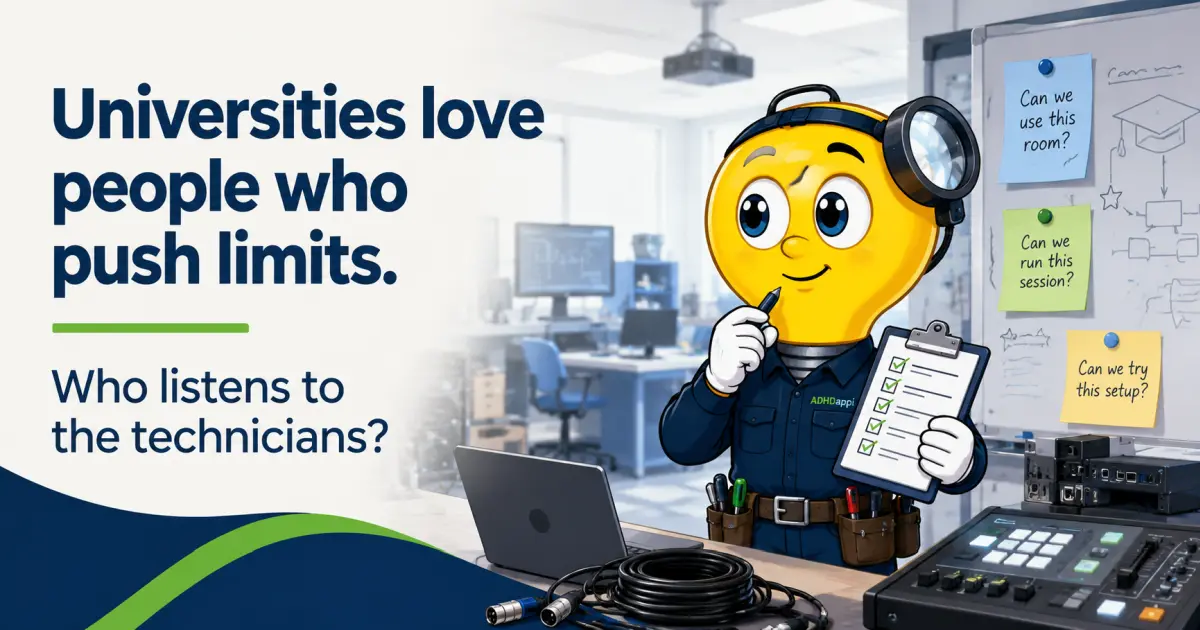
Universities love people who push limits. Who listens to the technicians?
Support for university technical and professional services teams
ADHDaptive works with neurodivergent professionals and university teams dealing with overload, pressure, unclear responsibility and work that keeps landing without enough control.
If this is showing up in your team, it may be worth looking at how work is planned, handed over and supported.
Why technicians matter
Universities are good at encouraging people to push limits.
That is part of the point.
New research. New methods. Specialist spaces. Unfamiliar equipment. Live systems. One-off teaching setups. Strange requests that do not quite fit the normal process.
A university should have room for curiosity. Research involves uncertainty. Teaching improves when people are willing to try something better than last year’s version.
But curiosity still has to meet the lab, the workshop, the studio, the server room, the timetable, the students and the safety procedure.
That is where technical staff come in.
They are the people asked to turn an idea into something that can actually happen. Safely. Practically. On time. With the right kit. In the right room. With the right people trained. With a plan for what happens if something fails halfway through.
That work is easy to underestimate from a distance.
A request may sound simple in a meeting.
- Can we use this room?
- Can we run this session?
- Can we try this setup?
- Can we connect this system?
- Can we use this material?
- Can we do it next week?
The technician may already be thinking about the part nobody has named yet.
- Equipment safety.
- Hazardous materials.
- Training gaps.
- Student behaviour.
- Access issues.
- System failure.
- Maintenance history.
- Room setup.
- Time pressure.
- What happens if the plan breaks halfway through.
That is not resistance. It is practical responsibility.

The pressure starts when responsibility arrives without enough control
A lot of technician pressure does not come from the task itself.
It comes from being made responsible for the practical risk after other people have already shaped the plan.
The room has been booked. The students have been told. The kit has been promised. The deadline is fixed. The expectation is already in motion.
Then technical staff are asked to make it work.
That is responsibility without enough control.
It is the kind of pressure that quietly wears people down because the technician may be held responsible for the reality, while having limited influence over the decision that created that reality.
This does not mean academics are careless.
It means the work is different.
An academic may be thinking about the research question, the teaching outcome, the grant, the method, the student experience or the thing they are trying to prove.
A technician may be thinking about what happens when that idea touches equipment, people, spaces, systems, materials and time.
Those are different types of responsibility. Problems start when only one of them is invited into the planning early enough.

Why universities make this worse
Accountability without control is not unique to higher education.
It happens in IT, healthcare, construction, local government, social care, corporate work and plenty of other places.
Universities add their own pressure because unusual work becomes normal.
In some workplaces, high-risk work is clearly separated from the everyday. It has its own space, process, access rules, checks and rhythm.
Universities are messier than that.
A lab may sit inside a wider world of teaching panic, research deadlines, room changes, student needs, academic autonomy, estates issues, finance processes, broken equipment and emails asking if something can be done “quickly”.
A specialist IT system may be treated like normal admin until it fails.
A workshop may be familiar to staff who use it every day, while still holding risks that need proper attention.
A studio may look relaxed from the outside, while technical staff are managing equipment, access, behaviour, deadlines and safety in the background.
The risk becomes familiar.
The unusual becomes ordinary.
That familiarity can be useful. It helps universities do interesting work. It also creates a blind spot.
People get used to the strange thing. They stop seeing how much judgement sits underneath it.
Technical staff are left working in that gap between academic ambition and practical reality.
The neurodivergent technician may see the weak point first
This is where ADHD and autism belong in the conversation.
Not as a soft add-on. Not as an awareness month poster. Not as a generic list of strengths and challenges.
The link is in the work itself.
ADHD and autistic technicians may be very good at spotting the weak point in a plan.
- The missing step.
- The unsafe assumption.
- The bottleneck.
- The unclear handover.
- The thing that sounds fine in a meeting but becomes a mess in the room.
- The system dependency nobody has checked.
- The risk that is technically covered on paper but shaky in practice.
That kind of thinking can be valuable in technical work.
It can also be misread.
If someone spots problems early, they may get labelled negative.
If they ask for clarity, they may look awkward.
If they need time to process competing demands, they may look slow.
If they push back against a rushed plan, they may be treated as blocking progress.
They may actually be protecting the work from a bad assumption.
That is a big difference.

Support has to match the real pressure
Neurodivergent support in technical teams cannot be vague.
It needs to match the real shape of the job.
A quiet room is useful for some people. Flexible working may help in some roles. Awareness training has its place if it leads to real change.
But none of that fixes a system where technical staff are brought in too late, given unclear requests, pulled in several directions and then expected to absorb the practical risk.
Better support looks more ordinary than people think.
- Bring technical staff into planning earlier.
- Check the practical risks before the promise is made.
- Be clear about who owns which decision.
- Give proper handovers.
- Stop treating every request as urgent.
- Build in time to recover after intense sessions, incidents or overload.
- Listen when someone says the plan has a weak point.
That last one is easy to say and harder to do.
Because in a busy university, the person raising the risk can feel like the person slowing everything down.
They may be the person stopping the work from becoming unsafe, unworkable or unfair.

Bring technicians in before the deadline becomes real
If universities want technical work to be safer, smoother and less stressful, technical staff need a stronger voice earlier in the process.
Not after the room is booked.
Not after the equipment is promised.
Not after the students have been told.
Not after the deadline has become real.
Before the plan has hardened.
This is not about giving technical staff a veto over curiosity. Universities need curiosity. They need people who push at the edge of what is known, what is possible and what has been done before.
But pushing limits works better when the people who understand the limits are part of the conversation.
Technical staff know the room, the kit, the system, the process and the risk.
Universities should listen to that knowledge before the idea becomes someone else’s emergency.
FAQs
Why do university technicians carry pressure without control?
Technicians are often asked to make a plan work after the room, kit, deadline or expectation has already been set. They may be responsible for the practical risk while having limited influence over the decision that created that risk.
Why should technical staff be involved earlier in university planning?
Technical staff understand the room, equipment, systems, safety procedure, access needs, training gaps and what happens if the plan fails halfway through. Bringing them in earlier helps stop curiosity becoming someone else’s emergency.
How can neurodivergent technicians help spot risks?
Some ADHD and autistic technicians may notice weak points early, including missing steps, unclear handovers, unsafe assumptions, bottlenecks or system dependencies that have not been checked. That thinking can protect the work.
Is technician pushback the same as being negative?
No. Pushback from technical staff may be practical responsibility. A technician raising a risk may be trying to stop the work becoming unsafe, unworkable or unfair.
What can universities do to reduce pressure on technical staff?
Universities can bring technical staff into planning earlier, check practical risk before promises are made, clarify decision ownership, improve handovers, stop treating every request as urgent and build in recovery time after intense work.
You can read more posts on ADHD, work pressure, higher education and neurodivergent support on the ADHDaptive blog.