
Rejection Sensitive Dysphoria and ADHD: What RSD Feels Like and What Helps
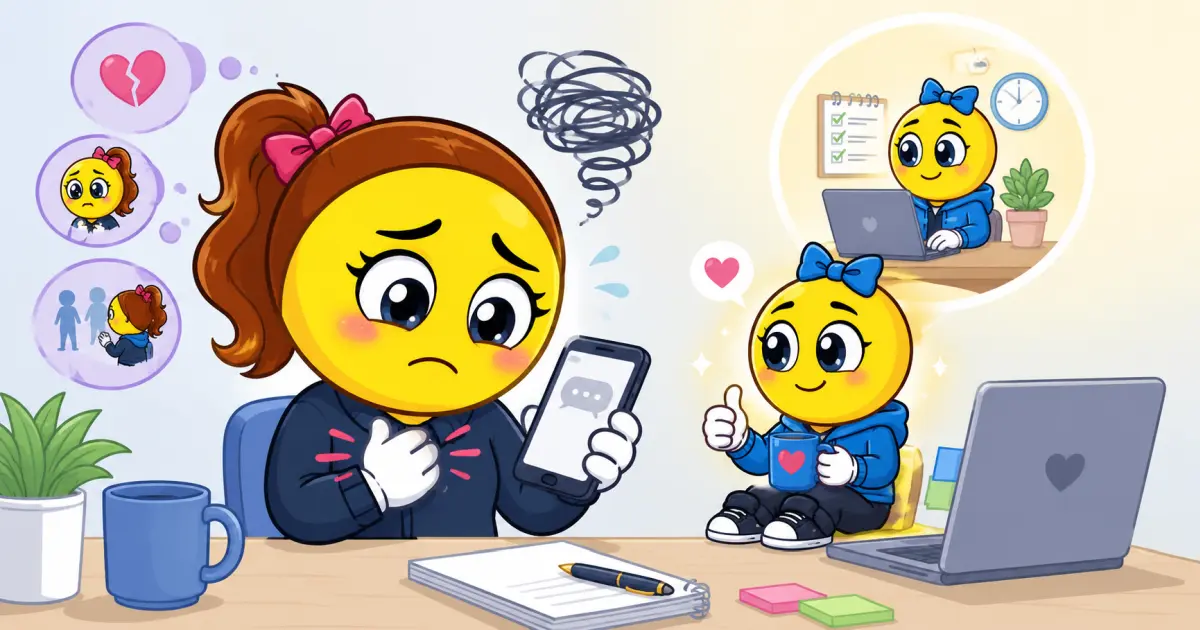
When a small moment feels enormous
A short message. No reply. A change in someone’s tone. A manager saying, “Can we have a quick chat?”
Nothing terrible has happened. At least, nothing you can point to.
But your body reacts before the sensible part of your brain has finished reading the evidence.
Your chest tightens. Your stomach drops. You replay the last conversation. You reread the message. You start building explanations, and most of them end with you having done something wrong.
I know that feeling.
Part of you may know there is probably another explanation. The person may be busy. The message may simply be brief. The feedback may be about one piece of work rather than your entire worth as a human being.
Knowing that does not always switch the feeling off.
Rejection sensitive dysphoria, often shortened to RSD, is a term many people with ADHD use for this kind of intense response to real or perceived rejection, criticism or failure.
The term needs a little care. RSD is not a formal diagnosis, and research into rejection sensitivity in ADHD is still developing. The lived experience is real, but I do not think we need to pretend the science is more settled than it is.
What is rejection sensitive dysphoria?
Rejection sensitive dysphoria is not a formal medical diagnosis.
It is a term used to describe intense emotional distress linked to rejection, criticism, failure or the feeling that one of those things may be happening.
People often talk about RSD in connection with ADHD. Emotional dysregulation is well recognised in ADHD research, and newer studies are looking more closely at rejection sensitivity in people with ADHD. There is still plenty we do not know.
Rejection sensitivity is not unique to ADHD either. Different people can become highly sensitive to rejection for different reasons and through different experiences.
I think this distinction is useful.
You can take the experience seriously without turning every painful social moment into proof of a condition. You can recognise a pattern without deciding that every difficult feeling has one cause.
For many people, the term RSD is useful because it gives language to something they have struggled to explain.
That was the useful part for me. The name did not solve anything. It helped me notice the pattern.

What rejection sensitivity can feel like
It can be hard to explain the speed of it.
You send someone something you worked hard on.
No reply.
Minutes pass. Then hours.
Your chest gets tight. You feel sick. You start replaying what you sent. Was the tone wrong? Did you miss something obvious? Have they finally realised you are not as capable as they thought?
Or perhaps they do reply, but the message is shorter than usual.
You notice the missing smiley face. The full stop. The fact they wrote “Thanks” instead of “Thanks so much”.
Part of you knows this is thin evidence.
Another part is already halfway through a trial in which you are the accused, the prosecutor and the person writing the verdict.
The feeling can show up as shame. Fear. Anger. A need to explain yourself immediately. A need to disappear. A sudden urge to resign, end the friendship, delete the message or send six more messages trying to fix something that may not be broken.
That intensity is one reason the phrase RSD has become meaningful to many people.
The reaction can feel physical too. Recent qualitative research into rejection sensitivity in people with ADHD describes participants reporting bodily distress alongside emotional pain. The study was small, so it should not be treated as the final word, but it gives useful weight to experiences people have been describing for years.
You can read the research context in the 2026 qualitative study on rejection sensitivity in ADHD.
The gap between what happened and what it feels like happened
This is one of the hardest parts.
The event and the emotional meaning can separate very quickly.
The event might be:
- A delayed reply
- A piece of corrective feedback
- A cancelled plan
- Someone sounding tired
- A manager asking for a meeting
- A friend spending time with someone else
- A joke that lands badly
The meaning your brain creates might be:
- They are angry with me
- I have failed
- I am going to lose my job
- They do not want me around
- I have embarrassed myself again
- I need to fix this now
The feeling is real.
The story attached to it may or may not be accurate.
I find that distinction much kinder than telling myself I am overreacting. It lets me take the emotion seriously without treating the first explanation as fact.
That can take practice, especially when the feeling has arrived at full volume.
How rejection sensitivity can affect work
Work gives rejection sensitivity plenty to work with.
There are hierarchies, feedback, performance conversations, unread messages, competing priorities, office politics and long stretches where nobody tells you whether you are doing well.
For somebody who is already sensitive to criticism or exclusion, uncertainty can become exhausting.
It may look like:
- Over-preparing for meetings because getting something wrong feels unbearable
- Avoiding questions because you fear looking incompetent
- Reading one piece of feedback as evidence that your job is at risk
- Going silent after criticism because you cannot process it in the room
- Becoming defensive before you have understood what was actually said
- Saying yes to too much work because disappointing someone feels worse than overload
- Avoiding applications, promotions or visible projects because rejection feels too risky
- Replaying a meeting for hours after everyone else has moved on
- Withdrawing from a manager after one difficult interaction
This can sit alongside other ADHD challenges such as emotional overwhelm, executive dysfunction or burnout.
It can also make unhealthy workplace behaviour harder to assess. A person may question whether they are genuinely being treated badly or whether they are “just being sensitive”. My article on ADHD, autism and gaslighting at work looks at that problem in more detail.
How rejection sensitivity can affect relationships
Relationships contain uncertainty too.
A friend takes longer to reply. A partner is quiet. Someone cancels a plan. You notice two people talking and wonder whether you were deliberately left out.
The painful part is not always the first feeling.
It is what happens next.
You may ask for reassurance, then feel ashamed for asking. You may withdraw before someone can reject you. You may become angry because anger feels easier than admitting you are hurt.
You may test the relationship without meaning to.
“It is fine. Forget it.”
It is not fine, and you do not want them to forget it.
You want them to notice that something is wrong without you having to risk asking directly.
I understand that impulse. I also know it can create exactly the confusion and distance you were afraid of.
This is where clear language can help more than mind-reading.
“I noticed I felt worried when I did not hear back. Are we okay?”
It may feel horribly exposed. But it gives the other person something real to respond to.
What can make the reaction harder to manage
I do not think there is one universal list. My own reactions are not identical from one day to the next.
But I notice that certain conditions leave less room between the feeling and the reaction.
- Being tired
- Already feeling burnt out or overloaded
- Unclear communication
- Public criticism
- Previous conflict with the same person
- Long periods of uncertainty
- Feeling trapped or powerless in a situation
- A recent run of criticism or rejection
- Pressure to respond immediately
Burnout can make everything thinner. There is less spare capacity to pause, check and recover.
If work pressure has been building for a while, ADHD burnout recovery may be useful alongside thinking about the rejection sensitivity itself.

What can help when the feeling hits
I wish there were a switch.
There is not one that I have found.
What helps me is creating a bit of distance between the first feeling and the next action.
That does not mean pretending I am fine. It means giving myself a chance to work out what is feeling and what is fact.
Some things that can help:
- Pause before replying to the message or email that triggered the reaction
- Write down exactly what happened without interpretation
- Write down the story your mind has added
- Ask what evidence supports the story and what evidence does not
- Wait until the physical intensity has dropped before making a big decision
- Ask a direct question when you need information rather than trying to decode tone
- Talk it through with someone outside the situation
- Notice repeated triggers so they are easier to recognise next time
- Repair after a reaction without turning the repair into self-punishment
One useful question for me is:
What do I know, and what am I afraid is true?
Sometimes the answer is uncomfortable. There may be real criticism or a real problem to deal with.
But dealing with the real problem is usually easier than fighting ten imagined ones at once.
If one situation is going round in circles, writing down what happened, what you fear and what you actually know can make the problem easier to examine.
How managers, partners and friends can help
You do not need to communicate perfectly.
You also do not need to remove all criticism or spend your life providing reassurance.
Clearer communication can still reduce needless uncertainty.
Be clear about context
“Can we talk later?” can mean almost anything.
“Can we talk later about next week’s rota? Nothing bad, I just need ten minutes,” gives the person useful information.
Make feedback specific
“This is not good enough” leaves a person guessing.
Explain what is wrong, what needs changing and what happens next.
Do not mock requests for clarification
If someone asks, “Are we okay?” you can answer the question without making them feel foolish for asking.
That does not mean you have to provide endless reassurance. It means one clear answer is kinder than ridicule or deliberate ambiguity.
Separate the work from the person
Feedback about one task is feedback about one task.
Say what worked too, when that is true. Not as a scripted praise sandwich, just as accurate information.
Give people time to process
Some people can hear difficult feedback and respond calmly ten minutes later, but not ten seconds later.
A short pause or a chance to return to the conversation can prevent a lot of unnecessary damage.
You are still responsible for what you do next
I want to be clear about this part.
A strong emotional reaction deserves understanding.
It does not give any of us permission to hurt people, attack colleagues, threaten relationships or demand that everyone around us removes every uncomfortable feeling.
I can be hurt and still be wrong about what happened.
I can need reassurance and still need to notice when I am asking for it repeatedly.
I can react badly and still repair the damage afterwards.
Understanding rejection sensitivity is not about finding an excuse.
For me, it is about having enough information to create a gap between the feeling and the action.
That gap is not always big. Sometimes it is tiny.
But tiny can be enough to stop one difficult moment turning into a much bigger one.
Support for rejection sensitivity and emotional overwhelm
If rejection sensitivity is affecting work, relationships or your confidence, you do not have to arrive with a perfect explanation of what is happening.
My ADHD coaching support for rejection sensitivity page explains how this can be explored through coaching.
For wider ongoing support, you can also read about ADHD coaching for adults.
If there is one specific message, conflict, decision or work situation you need to untangle, a Brain Session may be a better fit.

Frequently asked questions
What is rejection sensitive dysphoria?
Rejection sensitive dysphoria, often shortened to RSD, is an informal term used to describe intense emotional distress linked to real or perceived rejection, criticism or failure. The term is widely used in ADHD communities, but RSD is not a formal diagnosis and research is still developing.
Is rejection sensitive dysphoria part of ADHD?
RSD is not part of the formal diagnostic criteria for ADHD. Emotional dysregulation is well recognised in ADHD research, and recent studies are exploring rejection sensitivity in people with ADHD, but the relationship is still being studied.
What can rejection sensitivity feel like?
It can feel like a sudden rush of shame, hurt, fear or anger after criticism, silence, a change in tone or a perceived sign of rejection. The reaction can feel immediate and intense, even when part of you knows there may be another explanation.
What can help when rejection sensitivity hits?
It can help to pause before responding, separate the facts from the story your mind is building, write down what actually happened, delay important replies until the intensity drops, and ask a clear question when you need information rather than guessing from tone or silence.
How can managers, partners and friends support someone with rejection sensitivity?
Clear communication can help. Give context for feedback, avoid vague messages that create unnecessary uncertainty, explain the next step, and respond to requests for clarification without ridicule. Support does not mean removing all criticism or taking responsibility for another person’s reactions.