
Why “Normal” Is the Wrong Measuring Stick for Neurodivergent People
Using a Normal Measuring Stick Fails Neurodivergent People
The idea of using a normal measuring stick fails neurodivergent people and has always felt wrong to me. Yet, it is still the default. Every time we measure human worth by how well someone fits into outdated norms, we miss what truly matters.
The word “normal” gets thrown around so casually.
But no one ever really stops to ask — normal by
whose standards?
When my recent LinkedIn post went viral, the comments said it all.
People shared stories of frustration, misunderstanding, and plain exhaustion.
Not because of their
neurodivergence.
Because of being measured against the wrong yardstick.
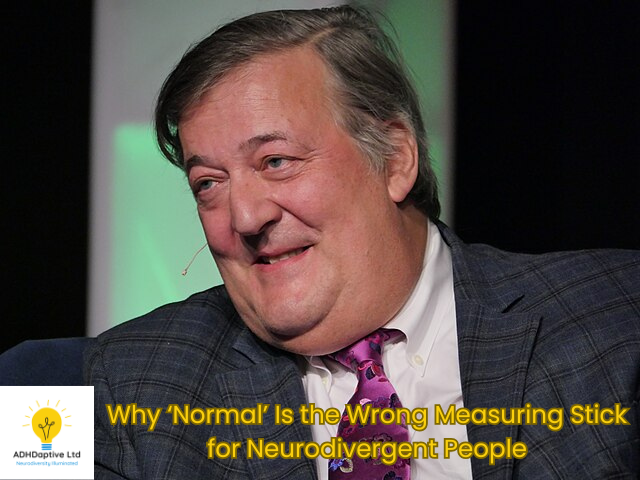
If you’re wondering where this all started, it was a clip of Stephen Fry that sparked the conversation. In a recent interview, he challenged the very idea of "normal" and asked us to rethink how we define difference. His words struck a chord with so many people, myself included.
You can watch the clip here: Stephen Fry on Neurodivergence (Instagram Reel)
It is well worth a minute of your time.
The Problem Isn’t Difference. It’s the Measuring Stick.
One comment summed it up perfectly:
“Difficulty fitting in might be the sanest response of
all.”

And it’s true.
We are expected to squeeze ourselves into systems that were never designed for minds like
ours.
Education, workplaces, even healthcare — all built around an idea of “normal” that is narrow,
outdated, and frankly, a bit dull.
When we don’t fit, the assumption is that we are the problem.
That we are broken.
That we need
fixing.
But what if the problem isn’t with us?
What if the problem is how we’re being measured?
Difference is Not Deficit
Another person asked why the conversation always assumes autistic or ADHD people struggle to understand
“normal” brains.
Why not ask why “normal” brains struggle to understand us?
That flipped perspective is powerful.
Because the truth is, different ways of thinking bring different strengths.
Curiosity, creativity,
problem-solving from angles others don’t see.
Yet, if those strengths don’t fit the narrow checklist of
“normal,” they get overlooked.
One person described how Stephen Fry was called a “sponge” for his curiosity.
That same trait, in a
different context, is often labelled as “distracted” or “too much.”
It depends on who is doing the
measuring.
Labels Are Tools, Not Definitions
Labels like “neurodivergent” can be helpful.
They give language to experiences many struggle to
explain.
They open doors to support and understanding.

But labels should never become cages.
When a label becomes a way to rank value or limit potential, it has lost its purpose.
We are all more than a label.
More than a diagnosis.
More than a tick-box on someone’s checklist.
What Should We Be Measuring Instead?
Instead of asking how well people fit into rigid systems, maybe we should ask:
- Are they able to use their strengths?
- Do they feel safe to show up as themselves?
- Are they being heard, not just managed?
- Is the environment flexible enough to allow different ways of working, learning, existing?
These are the measures that matter.
Not whether someone fits a standard that was never designed for them.
Normal Was Never the Point
The real issue is not about being “normal” or “different.”
It’s about recognising that diversity is
how humans survive and thrive.
Different ways of thinking are not obstacles to overcome.
They are assets we need.
Trying to flatten everyone into the same mould is not inclusion.
It’s erasure.
It’s time we stopped asking people to prove their worth by fitting into narrow definitions of
normal.
And started asking how we can make space for different minds to thrive.
I’d love to hear your thoughts.
Has “normal” ever been used as a stick to measure you
against?
How did that shape your experience?
Let’s keep the conversation going.
💬 Need ADHD Support?

ADHD isn’t just headlines, it’s real life.
If you’re looking for practical help, I
offer affordable ADHD coaching across Newcastle, Sunderland, Durham, Gateshead, Northumberland and
Teesside, and online UK-wide.
Sessions start from £75.
👉 Find out more about affordable ADHD coaching
👉 See coaching prices
👉 Book
a free chat