
Digital ID by Stealth: Why Online Safety Could Make the Internet More Dangerous
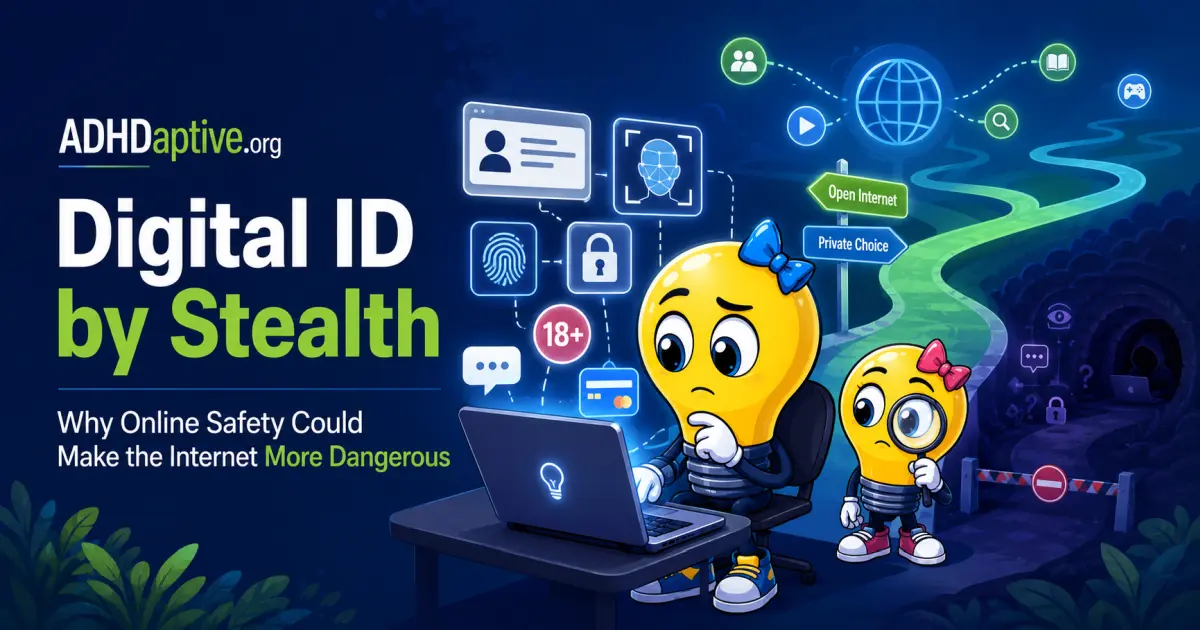
Something about the online safety debate keeps bothering me.
Not just the law.
Not just age checks.
Not just children being blocked from social media.
It is the pattern.
The public is being sold a very simple story.
Children are unsafe online. Social media is harmful. The government is stepping in. Anyone who objects must care more about adult freedom than child safety.
That is a neat little trap, isn’t it?
Because once child safety is used as the moral hostage, the real questions become very hard to ask.
- What data will adults have to hand over?
- Who stores it?
- Who checks it?
- What happens when it leaks?
- What happens when a child is pushed away from visible, regulated spaces and towards worse ones?
- What happens to neurodivergent children who rely on online spaces as their main social contact?
- What happens when the government does not technically censor anything, but pressures companies until they do it anyway?
That is the bit I can’t get past.
It’s a pattern.

Adults will have to prove they are adults
This is the thing that isn’t getting any attention.
Quite simply, you cannot age-check children without age-checking adults.
If a website, app, platform, shop, news site, forum, game, comment section, chatbot, or social space needs to know whether someone is under 16, under 18, or an adult, then every user becomes part of the checking system.
That means all adults may need to prove they are adults to access lawful parts of the internet.
Not illegal material.
Not abuse.
Not criminal content.
Lawful content.
Normal content.
Ordinary digital life.
And this is where the phrase “not mandatory” becomes a bit of a joke.
If you cannot use the internet properly without handing over ID, scanning your face, linking a bank account, using a credit card, or going through some third-party age assurance system, then it is mandatory in real life.
It does not matter what the policy wording says.
The choice becomes verify yourself, or be locked out.
In my book, that is not freedom.
“Social media” is not just Facebook and TikTok
Most people hear “social media ban” and naturally think of TikTok, Instagram, Facebook, Snapchat, YouTube, X and that whole attention-machine circus.
But the scope can become much wider than people realise.
A service does not need to resemble traditional social media to be part of this problem.
If people can comment, message, post, share images, upload content, interact with other users, speak to strangers, use a chatbot that connects to wider services, or take part in a community feature, then it will start being treated as part of the online safety machinery.
That could touch forums.
- Gaming.
- News websites with comments.
- Shopping sites with community features.
- Review platforms.
- Support spaces.
- Education tools.
- Online communities for disabled people.
- Suicide support sites.
- Apps young people use because in-person communication is hard.
The public thinks this is about stopping children from scrolling Instagram.
The actual machinery underneath is much bigger than that.

Children will not just go outside and play
This is the bit that makes me want to bang my head on the desk.
The argument seems to assume that if children are banned or blocked from social media, they will all return to some imaginary Victorian childhood of books, fresh air, wholesome hobbies, and knowing their place.
They won’t.
And, frankly, that version of childhood was mostly a fantasy the first time round.
Some might.
Lovely.
Many won’t.
Children do not stop needing contact, stimulation, identity, rebellion, privacy, escape, peer approval, novelty, or somewhere to put their feelings just because a platform says no.
- Some will use fake accounts.
- Some will use free VPNs.
- Some will borrow adult accounts.
- Some will move to less visible platforms.
- Some will end up on overseas services that do not care about UK law.
- Some will find Tor.
- Some will find darker corners of the internet than the ones adults were trying to block.
- Some will just become more secretive.
- And some may replace online risk with offline risk.
- Vandalism.
- Glue sniffing.
- Risky dares.
- Unsafe meetups.
- Older peer groups.
- Whatever gives them belonging, stimulation, status, or escape.
That is not me being dramatic.
It is basic human behaviour.
Take away one outlet without understanding the need underneath it, and the need usually leaks somewhere else.
Sometimes, somewhere worse.
Neurodivergent children are not an afterthought
This is where the whole thing becomes even more worrying.
For many neurodivergent children and young people, online spaces are not just entertainment.
They can be the only place they feel socially safe.
The only place they can speak.
The only place they can find people like them.
The only place they can communicate without eye contact, noise, school hierarchy, body language, playground politics, or the constant pressure to perform “normal”.
For autistic young people, online contact can be less overwhelming than face-to-face interaction.
For ADHD young people, online spaces can offer novelty, connection, fast feedback, shared interest, humour, and relief from boredom that feels physically painful.
For anxious young people, socially isolated young people, bullied young people, disabled young people, queer young people, late-diagnosed young people, or young people who do not feel safe at home, online spaces can be a lifeline.
Are there risks?
Yes.
Like all of life, of course there are.
There always have been.
But pretending the internet is only the danger, and not also the support, is lazy policy.
It is also dangerous.
Because if neurodivergent children lose access to their main form of social contact, they do not magically become less vulnerable.
They may become more isolated.
More hidden.
More ashamed.
More likely to seek contact somewhere less safe.

Bad age checks create new risks
The privacy risk is not theoretical.
Once people are required to prove their age or identity online, large amounts of sensitive information start moving through systems.
- Passport details.
- Driving licence details.
- Facial scans.
- Biometric estimates.
- Bank-linked checks.
- Credit card checks.
- Digital identity services.
Maybe some systems will be privacy-conscious.
Fine.
But people will not always understand the difference.
They will click through because they want access.
They will use whatever option is easiest.
They will use services they do not trust because the alternative is being locked out.
And once identity data is out there, it is out there.
You cannot change your face like you change a password.
You cannot un-leak a passport scan.
You cannot make fraudsters forget.
This is where the risks stack up.
- Identity theft.
- Scams.
- Blackmail.
- Fraud.
- Data breaches.
- False profiles.
- Children using adult details.
- Adults being impersonated.
- People being pressured to verify in unsafe ways.
And the more normal it becomes to hand over ID to access ordinary websites, the easier it becomes for criminals to copy that pattern.
A fake age-check page will not look strange if everyone is used to age-check pages.
That is the scammer’s dream.

Free VPNs are not a safety strategy
If children are pushed towards VPNs, especially free ones, that is not a win for child safety.
A good VPN can be a privacy tool.
A bad VPN can be a data-harvesting machine.
Children will not necessarily know the difference.
Let’s face it, many adults do not know the difference.
If a young person wants to bypass a block, they are unlikely to sit down with a cup of tea and review privacy policies, ownership structures, logging practices, DNS leak protection, jurisdiction, audit history, and whether the provider is selling their data through the back door.
They will download the one that works.
Probably the free one.
The one their mates use.
Probably the one shouted about on a forum.
Possibly the one that exposes them to more risk than the platform they were trying to access in the first place.
And if the next government move is to restrict VPNs too, then we are no longer just talking about child safety.
We are talking about weakening privacy tools used by adults, journalists, activists, abuse survivors, whistleblowers, disabled people, workers, and anyone who does not want every part of their online life tracked.
That is a very big price to pay for a policy that children may bypass anyway.
Australia should be treated as a warning
Australia’s under-16 social media ban isn’t going well.
Children are still using social media.
Some are bypassing checks.
Some are using fake accounts.
Some are finding workarounds.
This should surprise nobody who has ever met a teenager.
Teenagers test boundaries.
That is what they do.
The problem is not that teenagers are clever.
The problem is adults keep designing policy as if teenagers are furniture.
You cannot legislate curiosity out of a child.
You cannot ban social need.
You cannot block adolescence at router level.
If the Australian model is already struggling, copying it harder is not a plan.
The government gets plausible deniability
This may be the most sinister part.
The government does not have to stand there and say, “We are censoring you.”
It does not have to say, “We are creating digital ID by stealth.”
It does not have to say, “We are making private companies decide what you can access.”
It can simply create the legal risk.
Then platforms respond.
- They overblock.
- They age-gate.
- They demand ID.
- They blur.
- They remove features.
- They ban accounts.
- They restrict content.
- They make mistakes.
And when people complain, everyone points somewhere else.
The government says Ofcom is the regulator.
Ofcom says the platform made the decision.
The platform says it is complying with the law.
The regulator says it is enforcing Parliament’s rules.
The verification company says the check failed.
The user is left shouting into a form.
That is how accountability disappears.
With policy, outsourcing, liability, and corporate risk teams.
Far less theatrical and far more effective.
Pattern recognition is not paranoia
ADHD pattern recognition can be a double-edged sword.
It can run too fast.
Sometimes it connects things that do not belong together.
But sometimes, more often than not, it spots the direction of travel early.
And here, this direction of travel is not hard to see.
- Age checks.
- Identity checks.
- Device controls.
- Platform liability.
- Automated decisions.
- Restrictions framed as safety.
- Adults treated as suspicious until verified.
- Children pushed into hidden spaces.
- Neurodivergent people left out of the access conversation.
- Government pressure hidden behind corporate action.
- Everyone pretending this is just about children and TikTok.
It is not.
It is about whether internet access becomes conditional.
It is about whether anonymity survives.
It is about whether lawful speech and lawful content remain accessible without proving who you are.
It is about whether safety becomes the word we use when we do not want to admit we are building control.
We need better than this
Children need protection online.
I am not arguing against that.
Grooming, abuse, coercion, sextortion, harmful algorithms, self-harm content, eating disorder content, violent content, bullying, exploitation, and predatory adults are real problems.
But bad solutions can create new harm.
And using child safety to shut down criticism is not good enough.
- If a policy makes adults hand over identity data to access lawful spaces, that needs serious scrutiny.
- If a policy pushes children towards free VPNs, Tor, darker platforms, and services outside UK reach, that needs serious scrutiny.
- If a policy cuts neurodivergent children off from their only real social spaces, that needs serious scrutiny.
- If a policy gives the government plausible deniability while businesses enforce the restriction, it warrants serious scrutiny.
- If a policy creates more identity data for fraudsters, scammers and blackmailers to exploit, that needs serious scrutiny.
And if none of this is being properly discussed because everyone is terrified of being accused of not caring about children, then we have already lost the plot.
The question is not whether children should be safer online.
Of course they should.
The question is whether this actually makes them safer.
Or whether it builds a more controlled internet, exposes adults to new risks, pushes children into worse spaces, and leaves neurodivergent people carrying the cost first.
That is the pattern.
And quite simply, it is time we all started talking about it.

FAQs about digital ID, age checks and online safety
Is this article arguing against child safety online?
No. The article argues that children need protection online, but that bad policy can create new harm if it relies on broad age checks, identity systems, overblocking, or pressure on platforms.
Why would age checks affect adults?
Because a service cannot reliably age-check children without checking who is an adult. If ordinary online spaces need age assurance, adults can end up having to prove their age or identity to access lawful content.
Why are free VPNs a concern in this debate?
If children are blocked from major platforms, some may use free VPNs or less visible tools to get around restrictions. Poor quality VPNs can expose users to data harvesting, scams, tracking, or unsafe services.
Why does this matter for neurodivergent children and young people?
For some neurodivergent young people, online spaces are not just entertainment. They can be a main route into friendship, communication, shared interest, identity, and safer social contact.
What is meant by digital ID by stealth?
Digital ID by stealth means identity checking becoming normal through access rules, age assurance, platform liability, and third-party verification, rather than through an open public decision to require digital ID for ordinary internet use.
What is the main concern with the Online Safety debate?
The concern is that child safety may be used to close down criticism while bigger questions about privacy, lawful access, anonymity, data leaks, neurodivergent access, and accountability are left unanswered.
You can read more posts on ADHD, neurodivergence, digital access and policy on the ADHDaptive blog.