
Association for Coaching vs ICF vs EMCC: Why I Chose the AC
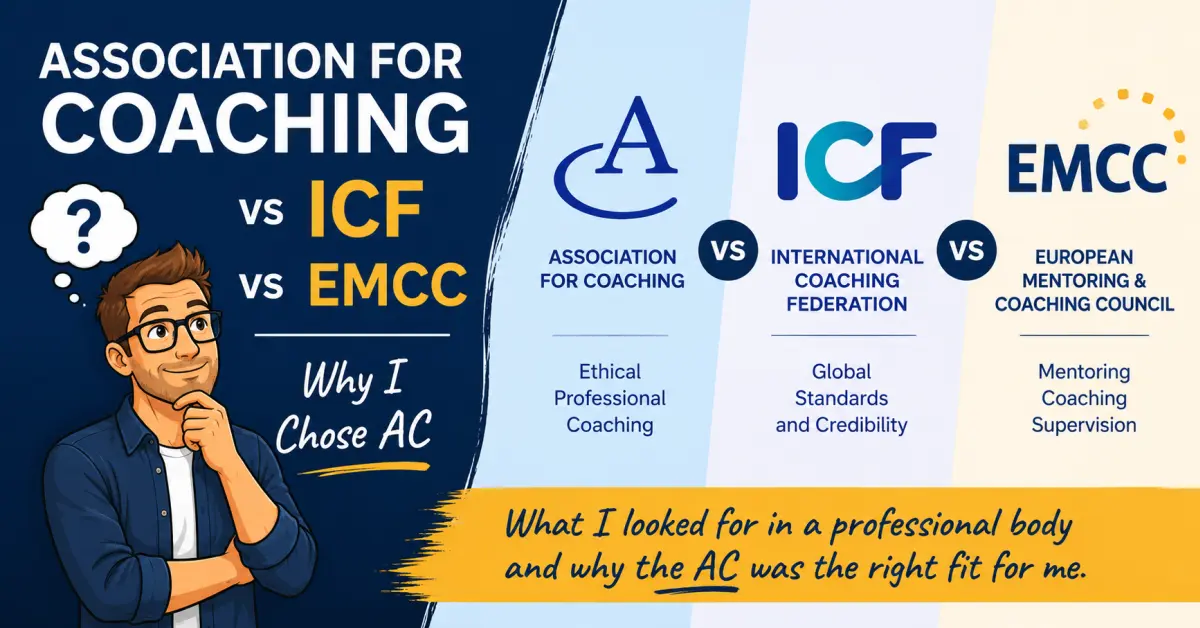
Why I compared the Association for Coaching, ICF and EMCC
When I started looking at professional coaching bodies, the same two names came up again and again.
ICF or EMCC.
Honestly, I almost stopped there and picked one. That was what everyone seemed to do.
My first reaction was probably predictable, at least for anyone who knows me well.
Why?
I had no objection to either organisation. They are large, established professional bodies with serious standards and international reach. What caught my attention was how quickly popularity seemed to become the answer. A lot of coaches join them because a lot of coaches join them, and after a while the crowd starts to look like evidence.
That makes me twitchy.
I have a stubborn streak. It has served me well at times and wasted a ridiculous amount of time at others. I can spend half a day questioning something another person would have sorted before lunch.
I have never been very good at choosing a path simply because lots of other people are already walking along it.
A fair amount of my coaching work involves helping people notice rules they have absorbed without ever consciously choosing them. People pick up ideas about how work should be done, what productivity looks like, how a career is meant to unfold and what a capable person should cope with. Often, nobody ever asked whether those ideas made sense for them.
It would be slightly ridiculous for me to spend my days questioning inherited rules with clients, then choose my own professional body by checking which logo appeared most often in other coaches' website footers.
I decided to look at the choices properly before joining anything.

Why professional membership was worth having
The National Careers Service says life coaching is not regulated in the UK and that people can work as life coaches without a mandatory qualification. That leaves clients with quite a lot of sorting to do for themselves.
A professional membership badge can only tell you so much. The same goes for qualifications.
I have met qualified people in many professions who I would not trust to organise a sock drawer.
Professional membership appealed to me because I care about standards, ethics, accountability and continuing learning. I also wanted a connection to the wider profession and a visible sign that I take the work seriously.
The body itself needed real criteria. Paying a fee and receiving a logo would have been pointless. I already have Canva. I can make myself a badge.
Clients deserve better than that.
The obvious choices were ICF and EMCC
The International Coaching Federation and EMCC Global are serious professional bodies. I am not writing this to take cheap shots at either of them.
ICF has clear eligibility rules for individual membership. Current routes include holding an ICF credential, having completed at least 60 hours of coaching education that meets ICF standards, or being enrolled in at least 60 hours of qualifying education.
EMCC Global has its own membership and individual accreditation routes. Its EIA accreditation looks at professional practice, client hours, continuing professional development, reflective learning and ongoing one-to-one supervision.
I respect all of that. I was trying to work out whether I had reached my own decision, or heard the same names so often that familiarity was starting to make the decision for me.
Popularity has a habit of feeding itself. People join the largest organisation because it is large and well known. Each new member adds to that visibility. The next person sees more badges, hears the name more often and reads more advice pointing in the same direction.
Nobody has to be doing anything wrong for that cycle to happen.
I just wanted to step outside it for long enough to make my own choice.
Agency is a big part of my work with clients. I would feel rather daft surrendering mine at the first sight of a popular logo.
Why the Association for Coaching caught my attention
The Association for Coaching was established in 2002. It describes itself as an independent, not-for-profit professional body with international reach.
It is also UK-based. Companies House lists a London registered office, while the AC describes its work as international. ICF lists its headquarters in Lexington, Kentucky, and EMCC Global has its registered office in Brussels.
For me, that was a point in its favour.
I work in the UK. My clients live and work here. The conversations I have with people often involve UK workplaces, Access to Work, reasonable adjustments, NHS diagnosis routes and our national talent for turning a simple administrative process into a small endurance event.
A British address does not automatically make an organisation better for a British coach. Geography alone would be a silly way to choose.
I liked the closeness of context. The AC felt connected to the professional world I actually work in, while still looking outward internationally.
Most people mentioned the AC after ICF and EMCC, if they mentioned it at all.
That made me curious enough to keep reading.
Criteria before decoration
The AC publishes entry requirements for its different membership levels.
Its Member level requires at least 50 hours of training in coaching or related disciplines and at least 25 hours of coaching delivery. The AC also has an Associate route for people with a general interest in coaching.
I liked that separation.
Membership and accreditation are different things, and I think those differences should stay visible. Joining a professional body should never be presented as proof of a level of accreditation that someone has not earned.
By the time I joined, I had already trained as an ADHD coach, worked with real clients and completed the AoEC Practitioner Diploma in Executive Coaching. I was looking for professional membership to sit alongside the work I had done and the work I am continuing to do.
I was not looking for a logo to cover an empty space.
That may be the stubborn part of me again.

My work does not sit neatly in one coaching box
My work covers ADHD and neurodivergence, late diagnosis, burnout, task paralysis, rejection sensitivity, emotional regulation, confidence, work pressure, planning, prioritising and reasonable adjustments.
I also work with managers and organisations.
There is executive coaching in that mix, along with specialist ADHD coaching and years spent inside organisations. I have watched systems work beautifully for one person and grind another person into dust while everybody calls the process fair.
I did not want to flatten all of that into a generic coaching identity because it was easier to explain.
The AC member directory lets people refine searches by the type of coaching they need. My own AC member profile has room for ADHD Coaching and Neurodiversity Coaching, along with the people I work with, my services, my interests and the way I approach the work.
I appreciated having room for the real shape of my practice.
ADHDaptive grew from lived experience, specialist training, years of organisational work and many conversations with people who had spent far too long believing they were failing at things everybody else seemed to manage. The ADHD part was there from the beginning. It was never a label added later because the subject had become fashionable.
I was looking for a professional home where I could describe that honestly.
What size can and cannot tell you
I think we sometimes give size more credit than it has earned. See a name often enough and it starts to feel proven, when really it may only be familiar.
Size can bring real advantages. Reach, resources, recognition and a large professional network all count for something. They still leave plenty of other questions to ask.
The AC has published membership criteria, accreditation routes, a professional directory, ethics commitments and continuing professional development opportunities. Its accreditation process asks for evidence including training, delivery experience, client references, supervision and continuing development records.
That gave me enough to judge the AC on what it actually does. I felt comfortable choosing it, and better for having paused long enough to make the choice myself.
This probably says quite a lot about how my brain works
I question things.
Sometimes far too much.
Tell me something is the obvious choice and my brain starts asking who decided that, what evidence they used, what got left out and how many people are repeating the answer because it is easier than reopening the question.
It is tiring sometimes, including for me. I also know it has saved me from accepting plenty of nonsense without checking it.
My ADHD and autistic traits affect the way I notice systems, rules, inconsistencies and assumptions. Accepted answers tend to hold my attention for about five minutes before I start checking them from every direction.
Usually I am trying to work out why an answer became accepted in the first place, and whether the reasoning still stands up.
Choosing the Association for Coaching came from the same place. I looked at the obvious options, respected what I found and kept looking until I had made my own choice.

Is the Association for Coaching better than ICF or EMCC?
I do not think that question has one honest answer for every coach.
A coach who works mainly with US clients may find ICF the clearest fit. Someone drawn to EMCC Global's strong focus on coaching, mentoring, supervision and reflective practice may feel more at home there. Some coaches belong to more than one professional body.
For me, the better question was this:
What am I joining, what will it ask of me, and does it fit the coach I am becoming?
My answer was the Association for Coaching.
I liked its UK base and international outlook. I respected the published entry criteria. I found room for ADHD coaching and neurodiversity coaching in the way members can describe their work. Standards and professional accountability were part of what I was looking for, along with the freedom to make the choice myself rather than borrow it from the crowd.
Perhaps I could have joined the organisation with the logo I saw most often and saved myself a lot of thought.
But then I would not really be me, would I?
FAQs
What is the Association for Coaching?
The Association for Coaching is an independent, not-for-profit professional coaching body established in 2002. It has an international outlook and publishes membership and accreditation criteria.
Is coaching regulated in the UK?
Life coaching is not regulated in the UK. The National Careers Service says anyone can work as a life coach if they feel they have the necessary skills and qualities, which is one reason professional membership and clear standards can help clients judge a coach.
What are the Association for Coaching Member entry requirements?
The Association for Coaching states that its Member level requires at least 50 hours of training in coaching or related disciplines and at least 25 hours of coaching delivery.
What are the ICF membership eligibility routes?
ICF says individual membership is open to people who hold an ICF credential, have completed at least 60 hours of coaching education that meets ICF standards, or are enrolled in at least 60 hours of qualifying education.
What does EMCC Global EIA accreditation look at?
EMCC Global says its EIA accreditation considers professional practice, client hours, continuing professional development, reflective learning and ongoing one-to-one supervision.
Is the Association for Coaching better than ICF or EMCC?
There is no single answer for every coach. The better fit comes down to the standards, routes, professional context and type of practice that make sense for the individual coach and their clients.
You can read more posts on ADHD, coaching, work and neurodivergence on the ADHDaptive blog.