
The ADHD Tax: Why ADHD Can Cost More Than You Realise
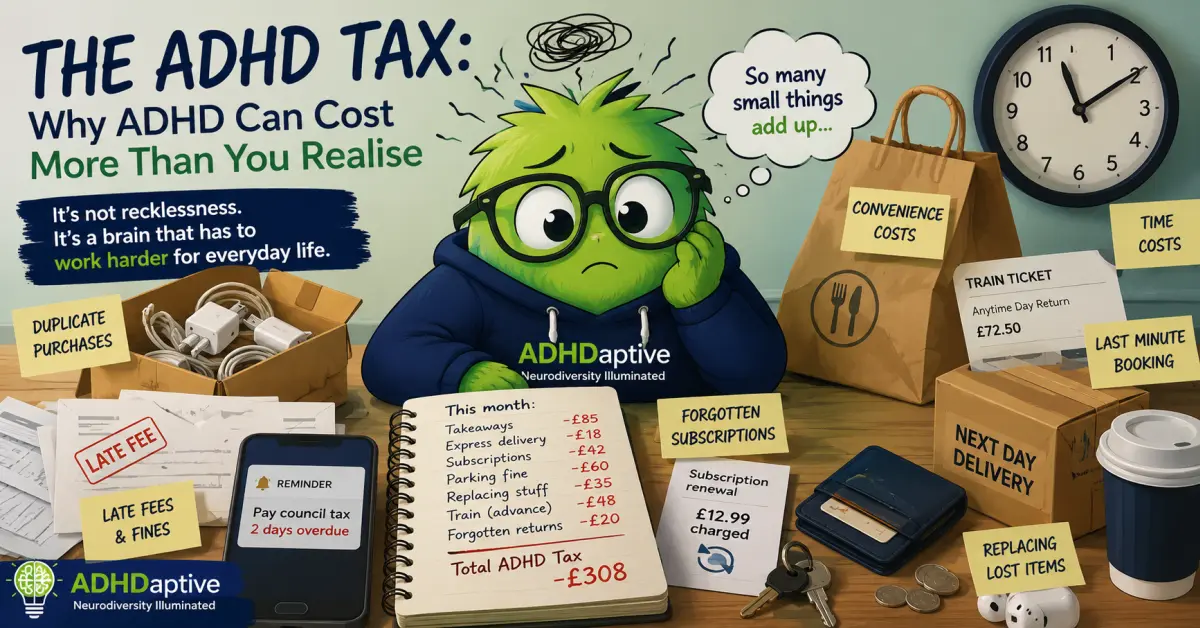
You are not bad with money because your brain missed a deadline
Ever opened a drawer and found three copies of something you forgot you already bought?
Paid a parking fine you meant to appeal?
Booked a train the night before because the date sat in your calendar for three months, then somehow became tomorrow?
Spent far too much on takeaways in one week because shopping, planning and cooking had all quietly stopped being possible?
That is the sort of thing people mean when they talk about the ADHD tax.
It is not a real tax. HMRC has not found another creative way to invoice us.
It is a community term for the extra money, time and energy that can disappear when ADHD and ordinary life collide.
Sometimes it is a £4 late fee.
Sometimes it is £300 because a contract renewed while you were still thinking about comparing alternatives.
Sometimes it is not really about money at all. It is an evening spent looking for something, a return deadline missed, a fridge full of good intentions going soft in the vegetable drawer.
Small things. Repeated often enough, they stop feeling small.

What is ADHD tax?
ADHD tax is an informal term used by people with ADHD to describe the extra costs that can come from the way ADHD affects everyday life.
It can include money lost through impulsive decisions, but that is only one part of it.
ADHD tax can also come from forgetting, losing track of time, avoiding a boring task, getting overwhelmed by too many steps, leaving something until it becomes urgent or needing the easiest available option because your capacity has gone.
The term is useful because it gives a name to something many people quietly blame themselves for.
You had the money for the bill. You still paid the late fee.
You wanted to return the shoes. The parcel sat by the door until the return window closed.
You bought food with every intention of cooking it. Wednesday arrived, your brain had other plans, and by Saturday half of it had gone off.
None of that means money does not matter to you.
It means the gap between intention and action can have a price attached.
It is not just impulse spending
People often reduce ADHD and money to one thing: impulsive shopping.
That can happen. I am not going to pretend otherwise. A purchase can feel very convincing at 11pm and rather less convincing when the parcel arrives.
But the wider ADHD tax is often much duller.
It is admin.
It is the ordinary stuff that nobody puts in a dramatic video because watching someone fail to cancel broadband for six weeks is not gripping television.
The costs can show up in several ways:
- Late fees on bills you intended to pay
- Subscriptions that renew before you cancel them
- Replacing things you cannot find
- Buying duplicate items because you forgot what you already own
- Missing refund and return deadlines
- Paying more for last-minute travel
- Using taxis because leaving on time failed
- Buying takeaway food when cooking has become too much
- Throwing away food you forgot was there
- Paying for memberships you stopped using months ago
- Missing early-booking discounts
- Buying supplies for a new interest that vanishes before the supplies arrive
One of these on its own may not look serious.
The problem is frequency. A tenner here, £30 there, another renewal, another lost charger, another train ticket bought too late.
Then you look at the account and wonder where the money went.
The small costs that keep adding up
ADHD tax often hides because each cost has a different explanation.
The takeaway was because you were tired.
The train was expensive because you booked late.
The replacement charger was only £15.
The subscription was forgotten.
The fine was annoying, but done now.
Seen separately, none of them looks like a pattern.
Seen together, there may be one.
Direct financial costs
These are the obvious ones. Fees, fines, renewals, wasted bookings, forgotten cancellations and purchases you did not really mean to make.
Convenience costs
These happen when the easiest route becomes the only route you can manage in that moment. Food delivery, taxis, express postage, pre-cut food, paying someone else to do a task you cannot start.
Waste costs
Food, duplicate purchases, hobby equipment, forgotten vouchers, unused memberships and items that were bought for a plan that never quite happened.
Time costs
Hours searching for lost things. Repeating work. Chasing missing paperwork. Sorting out avoidable problems after the easy deadline has passed.
Time costs are easy to ignore because nobody sends you an invoice for them.
They still take something from you.
Why ordinary admin can become expensive
There is no single reason ADHD tax happens.
Different people will recognise different parts of this.
Some people lose things constantly. Some do not.
Some spend impulsively. Some are so anxious about money that they barely spend at all.
For many adults with ADHD, ordinary admin can become harder when it asks for several things at once:
- Remembering that the task exists
- Starting it when there is no immediate reward
- Holding several steps in mind
- Estimating how long it will take
- Returning to it after an interruption
- Making a choice when there are too many options
- Acting before a future deadline feels urgent
A task can be simple and still be difficult to execute.
Take cancelling a subscription.
You have to notice the renewal. Remember the login. Find the page. Work through the cancellation screens. Resist the retention offer. Check that the cancellation actually happened.
None of those steps is hard on its own.
Together, at the wrong time, they can be enough to make “I’ll do it later” become another month’s payment.
This is why executive dysfunction can have such ordinary, expensive consequences.
The convenience tax
I think this part gets judged too harshly.
There are times when convenience spending is not careless spending. It is a way of getting through a difficult day.
A ready meal may cost more than cooking from scratch.
A taxi may cost more than the bus.
Paying for delivery may cost more than collecting something yourself.
That does not mean every convenience purchase is a good decision.
It means context matters.
The useful question is not always, “What is the cheapest option?”
Sometimes it is, “What is the cheapest option I will actually use?”
Buying vegetables that you repeatedly throw away is not cheaper than buying frozen vegetables you will eat.
Booking the 6am train because it is £12 cheaper is not cheaper if you repeatedly miss it.
A system that only works when you are having a perfect week is not much of a system.
The aim is not to remove every convenience cost. It is to notice which ones genuinely help and which ones keep appearing because the same preventable problem is repeating.

The cost of lost, forgotten and duplicated things
I have never met an ADHD person who needed a lecture about putting things in a safe place.
The problem is that safe places can become extremely safe. Archaeologists may find them one day.
Lost-item costs can look trivial until they keep repeating.
Chargers. Keys. Travel cards. Earbuds. Glasses. Documents. Medication boxes. The thing you bought last week and definitely put somewhere sensible.
Then there are duplicate purchases.
You are in the shop. You cannot remember whether there is toothpaste at home. Buying one feels safer than going without.
Later, you discover four tubes.
A useful response is not always “try harder to remember”.
It can be:
- Give high-cost essentials one visible home
- Keep cheap duplicates deliberately where they are genuinely useful
- Use a simple shared shopping list
- Photograph storage cupboards before a bigger shop
- Put trackers on items that are expensive to replace
- Keep returns physically in the place you leave from, not hidden in a tidy cupboard
The goal is not perfect organisation.
It is reducing the number of times the same problem charges you again.
The ADHD tax at work
ADHD tax can follow you into work too.
Not always as money leaving your bank account, but as money or time you never claim back.
You may recognise things like:
- Missing the deadline to submit expenses
- Losing receipts
- Forgetting to claim mileage
- Buying small pieces of equipment yourself rather than asking
- Paying for software because requesting it through work feels harder
- Avoiding forms linked to training, registration or promotion
- Spending unpaid time fixing something you forgot earlier
- Missing support because the application process feels too difficult to start
This is where support can make a practical difference.
If ADHD affects you at work, Access to Work may be worth exploring. It can help fund certain forms of work-related support, depending on your circumstances and the support agreed.
For self-employed people, I also have a page about Access to Work for self-employed neurodivergent people.
Getting support still involves admin, which is not exactly a joke anyone with ADHD needed, but it can be worth the effort.
The emotional cost of always paying more
The financial cost is only part of it.
ADHD tax can start changing the story you tell yourself.
- I am useless with money
- I cannot be trusted
- I am terrible at adult life
- Everyone else can do this
- I will never catch up
Then shame makes the next task harder.
You stop opening letters because you are afraid of what is inside.
You avoid looking at the bank account.
You leave the return parcel untouched because the deadline has already passed and now looking at it feels awful.
You hide a purchase from your partner because you are embarrassed.
You put off dealing with a £20 problem until it becomes a £200 one.
That cycle can become more expensive than the original mistake.
Shame is not a reliable admin system.
Seeing the pattern does not remove responsibility. It gives you a better chance of changing what happens next.
Ways to reduce ADHD tax without pretending you will become a different person
I am suspicious of advice that assumes tomorrow you will wake up as a person who loves spreadsheets, opens every letter immediately and has never lost a charging cable.
Work with the person who actually exists.
Start with the costs that repeat
Do not try to fix every financial habit at once.
Look for repetition.
What keeps costing you money?
Late bills? Food waste? Taxis? Forgotten subscriptions? Duplicate purchases?
One repeating cost is a better starting point than a total life overhaul.
Put reminders where action can happen
A reminder to cancel a subscription while you are driving is almost useless.
A reminder at 7pm with the cancellation link in the note has a better chance.
The reminder should not only tell you that something exists. It should help you start it.
Automate the boring predictable things
Automatic payments can reduce missed deadlines where they suit your finances and you have enough control over the account.
Calendar reminders for renewals can give you time to compare alternatives before the deadline becomes tomorrow.
A recurring monthly check can be enough. It does not need to become a three-hour personal finance retreat with colour-coded pens.
Create your own pause point for bigger purchases
A fixed rule such as “wait 24 hours before spending over £30” will not fit everybody.
Choose a limit that fits your own money.
The amount matters less than creating some distance between wanting and buying.
Add it to a list. Leave the tab open. Take a screenshot. Give the idea somewhere to live that is not the checkout.
Build a small reality buffer
If your budget only works when nothing goes wrong, it probably will not survive real life.
A small buffer for replacement items, late changes or convenience spending can be more honest than pretending those things will never happen again.
It is not permission to spend carelessly.
It is planning for a life that has already shown you where the weak spots are.
Build systems around what actually happens
The best system is not the neatest one.
It is the one you still use three weeks later.
That might mean:
- One basket for unopened post
- One place for receipts you need to claim
- One visible shopping list shared on your phone
- Frozen food for the days cooking will not happen
- A spare charger kept at work on purpose
- A calendar reminder before a subscription renewal, not on the day
- A weekly ten-minute account check instead of one huge monthly reckoning
- A trusted person who can sit with you while you deal with one avoided task
The point is not to build a perfect life.
It is to reduce the number of times the same friction charges you money, time or confidence.
Sometimes the problem is not lack of knowledge. You know the bill needs paying. You know the parcel needs returning.
The problem is getting from knowing to doing.
That is a common ADHD coaching topic, and it links closely with task initiation, time blindness, working memory and procrastination.

When you need help untangling the pattern
Money and admin problems are often tangled up with task initiation, avoidance, shame, impulsivity and systems that looked good on paper but never fitted real life.
ADHD coaching is not financial advice.
It can help you look at what keeps happening, where the friction sits and what sort of practical support might fit the way you actually work.
You can read about ADHD coaching for adults or use a Brain Session for one specific stuck point, decision or admin problem you need to untangle.
Frequently asked questions
What is ADHD tax?
ADHD tax is an informal community term for the extra financial, practical and time costs that can come from ADHD-related difficulties such as forgetfulness, impulsivity, losing things, missed deadlines, task avoidance and last-minute decisions.
Is ADHD tax only about impulse spending?
No. Impulse buying can be part of it, but ADHD tax can also include late fees, forgotten subscriptions, wasted food, replacement items, missed refunds, taxis, express delivery and paying more because an ordinary task became urgent.
Why can ADHD make ordinary admin more expensive?
Tasks such as comparing prices, cancelling contracts, returning items, paying bills and keeping receipts can involve several steps and delayed rewards. Difficulties with working memory, task initiation, time awareness and avoidance can make those tasks harder to complete before a deadline.
How can I reduce ADHD tax?
Start with the costs that repeat. Put bills on automatic payment where appropriate, place reminders where you can act on them, create one home for important items, use a pause before larger purchases, and build a realistic buffer for the mistakes that still happen.
Can ADHD coaching help with money and admin problems?
ADHD coaching can help you examine the patterns behind missed tasks, avoidance, impulsive decisions and systems that keep failing. Coaching is not financial advice, but it can help you build practical ways of managing the behaviours and routines around money and admin.