
ADHD at University: Why Capable Students Struggle and What Actually Helps
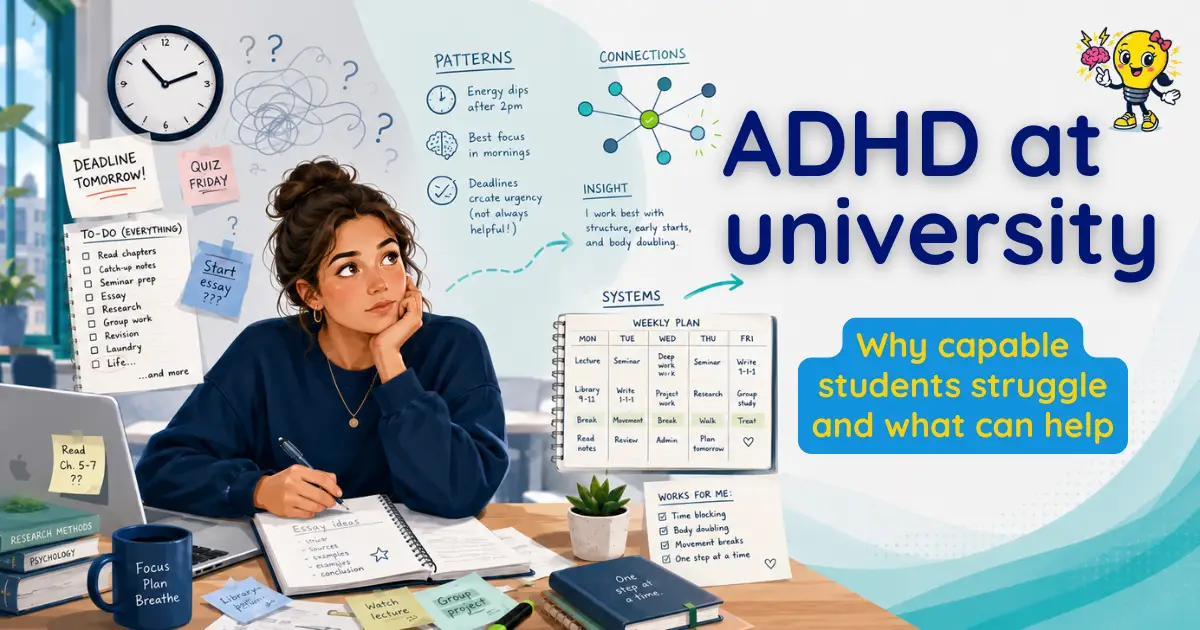
You did well at school, so why is university falling apart?
You understood the work. You got the grades. You may have been the person who could leave an essay until the last minute and still hand in something good.
Then university arrived.
Lectures are optional, or at least feel optional. Deadlines sit weeks away. Nobody checks whether you got out of bed, opened the reading or understood what "independent study" was meant to look like. One missed seminar becomes three. An assignment moves from difficult to emotionally radioactive.
You still know you are capable. That can make the whole thing more confusing, because your results and your daily reality seem to belong to two different people.
This is a common point where ADHD difficulties become much harder to hide. The academic ability is still there. The structure around it has changed.
When the structure disappears

School and college usually provide a timetable, visible teachers, regular reminders, shorter deadlines and a fairly obvious next step.
University gives you freedom. It also hands you a large amount of invisible management work and calls it independence.
A student may have only a few scheduled contact hours, then be expected to organise reading, research, writing, revision, meals, sleep, money, laundry, travel, medication, appointments and a social life around them.
That is not a small change. It places far more demand on executive function, including starting tasks, holding information in mind, judging time, switching attention and deciding what matters now.
This is why strong school results can hide a real difficulty. Intelligence may help you understand the work. It cannot always make your brain begin it at 10am on a quiet Tuesday when the deadline is still four weeks away.
If the gap between knowing and doing feels familiar, read my explanation of ADHD executive function and why knowing is not enough.
What struggling can look like
University difficulty does not always look like failing every module. A capable student may still produce good work, but the cost becomes ridiculous.
Academic work
- Waiting for panic before starting
- Avoiding assignments that feel vague
- Reading the same page without taking it in
- Missing small tasks while completing harder ones
- Working through the night before a deadline
Daily life
- Sleep drifting later each week
- Forgetting meals, medication or appointments
- Avoiding email because one message feels difficult
- Running out of clean clothes at the worst moment
- Money disappearing through forgotten admin
What other people see
- Good grades, sometimes
- A student who seems bright and articulate
- Last-minute requests for help
- Inconsistent attendance
- Someone who appears fine in a ten-minute conversation
The inconsistency often creates shame. If you can do excellent work once, people assume you should be able to do it every time. You may assume that too.
But performance under emergency pressure is not the same as having a repeatable way to work.
Pattern spotting before problem solving

Most advice begins with the solution. Get a planner. Start earlier. Make a timetable.
I would begin one step back. What actually happens?
Pick one repeated problem and trace it without turning the exercise into a trial.
- Which tasks do you avoid, and what do they have in common?
- Does the problem begin with boredom, uncertainty, perfectionism or too many possible starting points?
- When do you focus more easily?
- Does another person's presence help?
- Do you lose momentum after interruptions?
- What makes a planner disappear from your attention?
- What has worked before, perhaps by accident?
A failed system is evidence. Maybe it required too many decisions. Maybe it lived inside an app you stopped opening. Maybe it planned an imaginary version of you who wakes at 7am, studies for six hours and never has a bad day.
Once you can see the pattern, you can change the conditions around it.
This is the same thinking behind my post on why more reminders are often the wrong answer for ADHD.
When normal study advice is the wrong advice
Standard advice is not automatically bad. It becomes a problem when the method is treated as correct and the student is blamed when it fails.
You do not need to become better at using somebody else's system.
You need to understand your patterns well enough to build one that works for you.
"Use a detailed planner"
A detailed planner may create more admin than clarity. A visible weekly sheet with three priorities may work better.
"Start at the beginning"
The first section may be the hardest entry point. Starting with the easiest paragraph, diagram or rough voice note can create movement.
"Study somewhere quiet"
Silence may leave too little stimulation. A library, café or body double may help attention stay connected.
"Plan the whole term"
A semester plan can become wallpaper. Planning one week, or one day, may keep the work visible.
"Prioritise by importance"
Importance is only one factor. Energy, urgency, clarity and ease of entry can decide what you can start now.
"Try harder"
More force is not a method. Change the task, the environment, the timing or the support around it.
Build a system that works for you
Do not try to repair your entire university life on Sunday night. Choose one repeating problem and run a small experiment.
Name the real problem
Use something observable, such as missing seminars, avoiding email or starting essays the night before.
Trace the pattern
Look at what happens before the problem. Notice the task, time, place, emotion and first point where you drift away.
Find the friction
Is the task unclear, boring, too large, hidden, emotionally loaded or waiting for information you do not have?
Change one condition
Try body doubling, a rough first draft, a visible prompt, an earlier checkpoint or a different place to work.
Review what happened
Keep what helped. Change what did not. No loyalty is owed to a method merely because it appears in a study-skills handbook.
Some students work better with short bursts. Some need a long warm-up. Some need company. Some need headphones and movement breaks. The useful question is not, "What should work?" It is, "What changed the result?"
If starting is the main barrier, my ADHD task initiation guide goes into that problem in more depth.
What to try this week

Choose one piece of work you are avoiding. Write down the first physical action, not the whole project.
"Open the assignment brief and highlight the verbs" is a starting action. "Do essay" is a threat written as a task.
- Book a library slot with someone else.
- Ask a tutor one clear question before the task grows teeth.
- Create a rough version that is allowed to be bad.
- Put the next action somewhere you will physically see it.
- Set a checkpoint before the real deadline.
- Review whether the change helped, rather than whether you followed it perfectly.
Support through your university and Disabled Students' Allowance
You do not have to solve all of this alone.
Contact your university disability, inclusion or student support team. The name varies, but the job is broadly the same: talk through how your condition affects study and what support or reasonable adjustments may be available.
Possible support can include changes to teaching or assessment arrangements, specialist study support, assistive technology and clearer ways to access course materials. What is offered will depend on your needs, course and university.
For students ordinarily resident in England, the UK Government says ADHD can meet the eligibility rules for Disabled Students' Allowance when it affects your ability to study. You will need suitable evidence.
Disabled Students' Allowance can help with study-related costs linked to a disability. The support is based on individual need rather than household income, and it does not need to be repaid. Funding systems differ across the UK, so check the rules for the nation that funds you.
Apply early. Support can take time to arrange, and waiting until everything has already collapsed makes an awkward process much harder.
A note for parents reading this
You may be able to see the pattern long before your son or daughter wants to discuss it. That does not make the next step simple.
Repeated reminders can turn every conversation into another instruction. Taking over can protect the deadline while weakening independence. Vanishing completely can feel less like freedom and more like abandonment.
The aim is to support the young adult to see what is happening and take part in building the response. My article on supporting a young adult with ADHD without nagging looks at this more closely.
How my coaching can help university students

It is hard to spot your own patterns while you are living inside them.
In coaching, we look at what repeatedly happens, find the point where things break down and test practical changes around the way you actually work.
This is not tutoring. I do not teach your subject, write assignments or police your timetable.
I can help you:
- Spot patterns behind avoidance, missed deadlines and inconsistent attendance.
- Work out whether the friction is uncertainty, perfectionism, energy, memory, emotion or task design.
- Challenge approaches that keep failing rather than blaming yourself for them.
- Build practical systems around study, routines, communication and daily life.
- Create enough structure to help without trying to recreate school.
- Review what works and adjust it as university demands change.
ADHD coaching for young adults is the main route for ongoing support. A focused ADHD Brain Session may fit better when you have one immediate problem, decision or stuck point to untangle.
Capable, but university is becoming harder than it should be?
Book a free informal coffee and chat. We can talk about what is happening, what you have already tried and whether coaching would be useful.
Book a coffee and chatFAQs about ADHD support at university
Why can ADHD become harder at university?
University often removes the external structure that helped at school. Students may need to manage large blocks of unstructured time, vague assignments, competing deadlines and daily life without regular prompts. That can expose executive function difficulties that were easier to manage before.
Can you do well at school and still struggle with ADHD at university?
Yes. Strong grades do not rule out ADHD difficulties. A student may understand the subject and still struggle with starting, planning, remembering, regulating sleep, attending consistently or completing work without intense last-minute pressure.
What support can university students with ADHD ask for?
Contact your university disability or student support team to discuss reasonable adjustments and study support. Students in England whose ADHD affects their studies may also be eligible for Disabled Students' Allowance, subject to current eligibility and evidence rules.
What if planners and revision timetables never work for me?
A failed planner is information, not proof that you are incapable. Look at when the system disappeared, what created friction and what conditions helped you act. A smaller visible system, body doubling, shorter planning periods or external checkpoints may fit better.
Can ADHD coaching help university students?
ADHD coaching can help you spot repeated patterns, understand where tasks break down and test practical systems around study, routines, energy, communication and daily life. Coaching is not tutoring and does not replace university disability support.
You can read more posts on ADHD, work and neurodivergence on the ADHDaptive blog.